
Sikkim Chief Minister Prem Singh Tamang has made a controversial statement, saying that the Trinamool Congress (TMC) government in the neighboring state of West Bengal had posed a threat to national security. He made this remark while speaking to a Guwahati-based electronic media outlet during his participation in the 73rd Plenary Session of the North Eastern Council (NEC) held in Shillong yesterday. According to the Chief Minister, the TMC government in West Bengal should have been voted out in the 2021 Assembly elections itself.
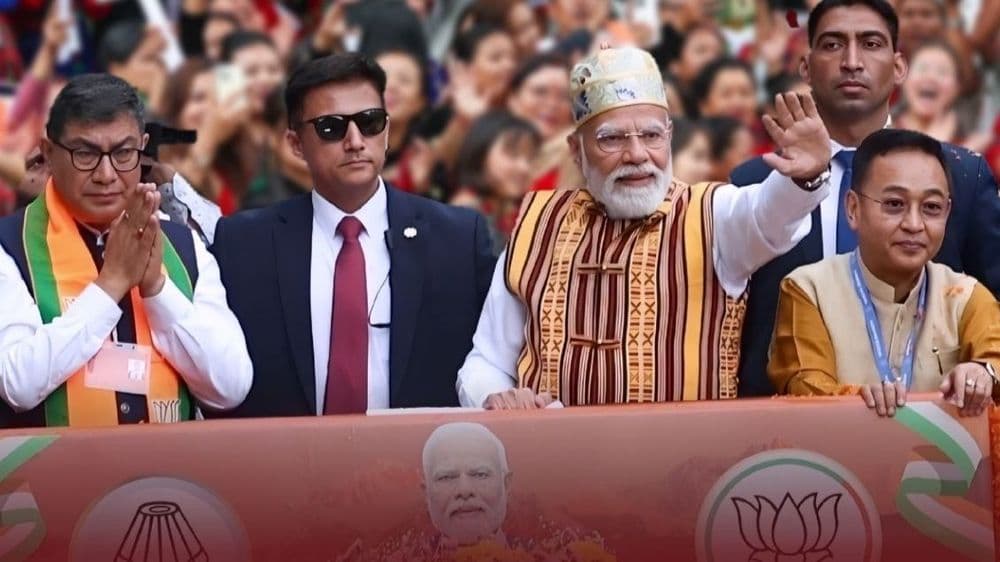
It is noteworthy that in the recently concluded Assembly elections, the Bharatiya Janata Party (BJP) succeeded in unseating the TMC, which had been in power continuously for the past 15 years, and formed the government in West Bengal for the first time. Sikkim's ruling party, the Sikkim Krantikari Morcha (SKM), is a constituent of the BJP-led National Democratic Alliance (NDA) at the Centre. Chief Minister Prem Singh Tamang was also present as a special guest at the swearing-in ceremony of West Bengal’s newly elected Chief Minister, Suvendu Adhikari.
Although Chief Minister Tamang stated in his interaction with the media that the TMC government in West Bengal had been a threat to national security, he did not explain the specific reasons why he believed it posed such a threat. It is worth mentioning that while the TMC was in power, Tamang had never publicly made such strong remarks against the party or its government. Even when the West Bengal administration halted the foundation-laying ceremony for infrastructure development on land owned by the Sikkim Government in Siliguri, he had refrained from strongly criticizing the Bengal government. However, Tamang now believes that the formation of a BJP government in West Bengal is beneficial not only for the state but for the entire nation.
Responding to a journalist’s question on how a BJP government in West Bengal would benefit Sikkim, Tamang referred to the incident in which local authorities had stopped the Sikkim Government from carrying out infrastructure development on its own land at the SNT complex in Siliguri. He described the issue as a “syndicate system,” which he claimed has now come to an end. He also expressed confidence that the alleged practice of imposing excessive taxes on Sikkim-registered vehicles in Siliguri—a city of great importance to Sikkim—would also be discontinued.