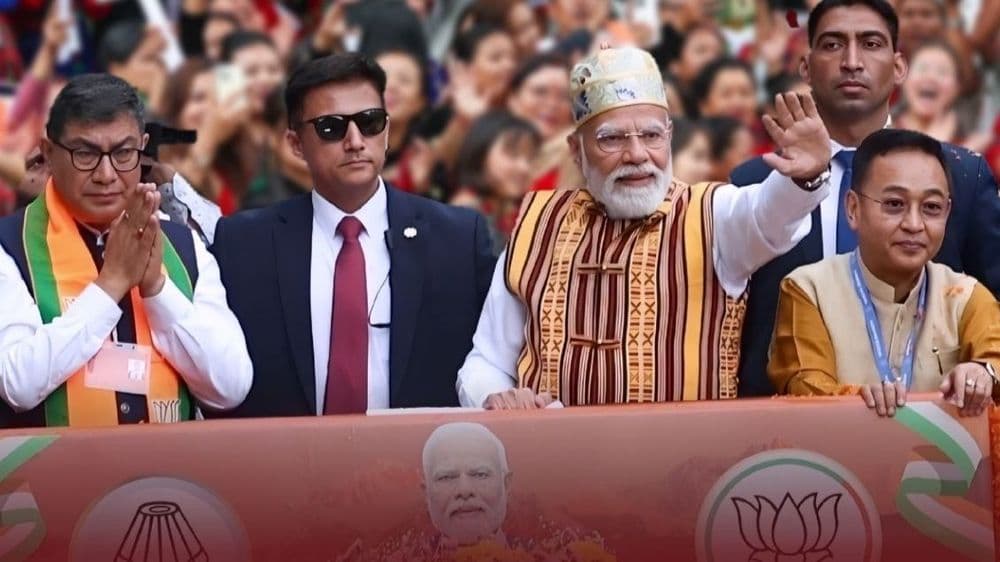
In the political history of West Bengal, the 2026 election is increasingly being viewed not merely as a change of government but as a watershed moment. The victory of the Bharatiya Janata Party (BJP), which defeated the All India Trinamool Congress (TMC) after 15 years in power, carries a significant political message. Public dissatisfaction with the government led by Mamata Banerjee, a desire for change, and the search for an alternative political force are widely believed to have contributed to this outcome. The BJP has described the result as a “mandate for change” and has claimed that West Bengal is now set for a new transformation.
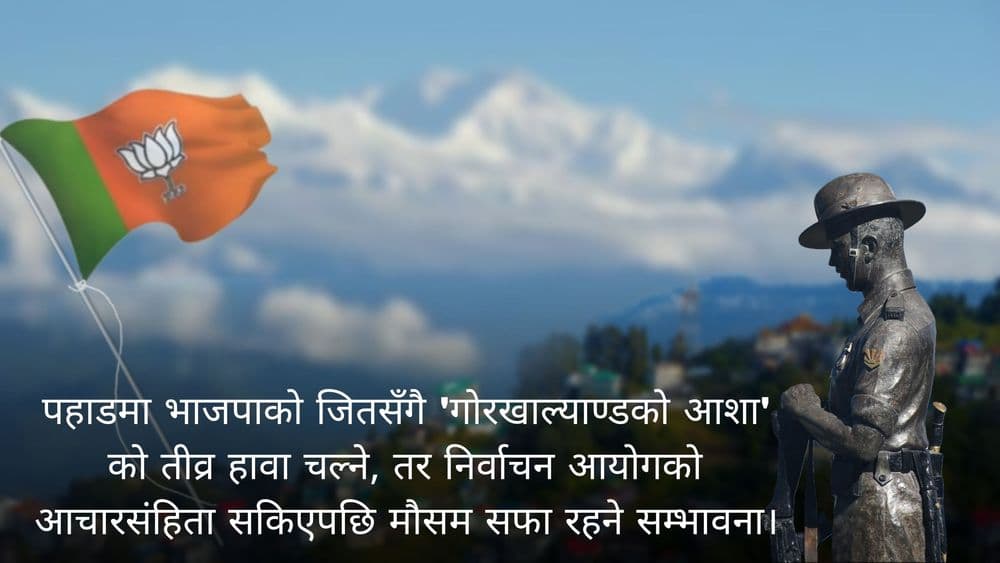
However, the impact of this political change is perhaps even more profound in the Darjeeling Hills, a region whose politics has always been distinct, sensitive, and closely tied to issues of identity. BJP’s victory in all three hill constituencies—Darjeeling, Kalimpong, and Kurseong—once again demonstrates that the people of the hills continue to look toward national political forces for solutions. This support is not merely loyalty to a political party; it is also rooted in the long-standing hope associated with the unresolved demand for Gorkhaland.
For more than a decade, the people of the Darjeeling Hills have consistently supported the BJP. Many political observers credit Bimal Gurung as the key figure who established this relationship, beginning in 2009. It was under his leadership that the hill movement was connected to national politics and that the BJP gained a foothold in the region. Critics, however, argue that these victories are not the result of any one leader’s influence but rather reflect the people’s own desire for political change.
The political landscape of Darjeeling underwent significant upheaval after 2017. The movement, administrative pressures, and internal divisions weakened both the Gorkha Janmukti Morcha (GJM) and Bimal Gurung. Yet, following the 2026 election results, Gurung’s political influence appears to be growing once again. The expansion of his organization, the reunification of workers, and the increasing number of people joining the GJM suggest that he is making a determined effort to re-establish himself as the central figure in hill politics.
This raises an important question: Is Bimal Gurung once again on the path to becoming the dominant leader of the hills? In the past, supporters referred to him as a “Tiger,” symbolizing his strong and decisive leadership. Today, however, the political environment is far more fragmented, multi-party, and complex. Whether his political comeback proves lasting or temporary will depend on the choices and strategies he adopts in the coming years.
If Bimal Gurung regains dominance in hill politics, what strategy will be adopted by the Bharatiya Gorkha Prajatantrik Morcha (BGPM), which currently governs through the GTA under the leadership of Anit Thapa? Relations between Gurung and Thapa have not been cordial. In such a scenario, Thapa’s statement that “we worked with the government yesterday, we are working with it today, and we will continue to work with it tomorrow” will face a real test. The government in power is led by the BJP, and the BJP’s principal ally in the hills remains the Gorkha Janmukti Morcha. Whether Bimal Gurung will readily accept Anit Thapa’s position remains uncertain.
On the other hand, when the GJM was not aligned with the BJP, the Gorkha National Liberation Front (GNLF) provided significant support to the party through alliance politics. Since 2019 in particular, the GNLF has consistently stood alongside the BJP. In the latest election, former Darjeeling MLA and GNLF leader Neeraj Zimba even sacrificed his own electoral ticket in support of the BJP. Neither did the GNLF exert pressure for ticket allocation, nor did Zimba pursue his personal ambition of securing a third consecutive victory. This move clearly demonstrated the party’s commitment to the alliance.
Nevertheless, the close relationship between the GNLF and BJP has also attracted criticism. Some critics argue that the GNLF weakened because of its proximity to the BJP, even claiming that “the BJP destroyed the GNLF.” Yet current developments suggest that such allegations do not fully reflect reality. On the contrary, the GNLF has been actively expanding its organization, and membership has been growing in various regions.
The GNLF has also continued to pursue its long-standing political agenda, particularly its demand for a solution under the Sixth Schedule of the Constitution. The party presents this as a potential pathway toward resolving the political issues of the hills.
The central question, however, remains: What is the solution?
Electoral victories alone cannot resolve the decades-old issues of the Darjeeling Hills. Leaders such as Raju Bista have repeatedly claimed that a political solution is near. Bimal Gurung speaks of achieving the “best of the best solution.” Yet the public wants clarity about what exactly that solution entails.
Is it recognition for the 11 Gorkha communities? Is it a Permanent Political Solution (PPS)? Is it autonomy under the Sixth Schedule? Or is it ultimately a separate state of Gorkhaland?
All of these options have been discussed for years, yet none has been fully implemented. As a result, hope and frustration continue to coexist among the people.
Meanwhile, new political forces are also emerging. The Indian Gorkha Janshakti Front (IGJF) has been raising its voice against corruption and establishing its presence through grassroots development initiatives, including road construction and infrastructure projects. Many people have responded positively to these efforts. However, the party’s greatest weakness remains the absence of a clear and concrete political agenda. A slogan such as “a party born for Gorkhaland” may not be enough to secure long-term public support unless it is backed by a practical and achievable roadmap.
Overall, the political transformation of 2026 has revealed three major trends in the hills. First, the people still possess patience, but not indefinitely—they now want results. Second, old political leaders are making comebacks, but their credibility is being tested. Third, new political forces are emerging, but they have yet to define a clear direction.
Ultimately, the politics of the Darjeeling Hills is currently in a period of transition, where hope, uncertainty, and power struggles coexist. If the BJP succeeds in delivering a concrete political solution as promised, this moment could become historic. However, if the promise remains limited to election slogans, public trust in the hills may once again suffer a serious setback.
For this reason, the present moment is not merely about a change of power—it is a test of trust.